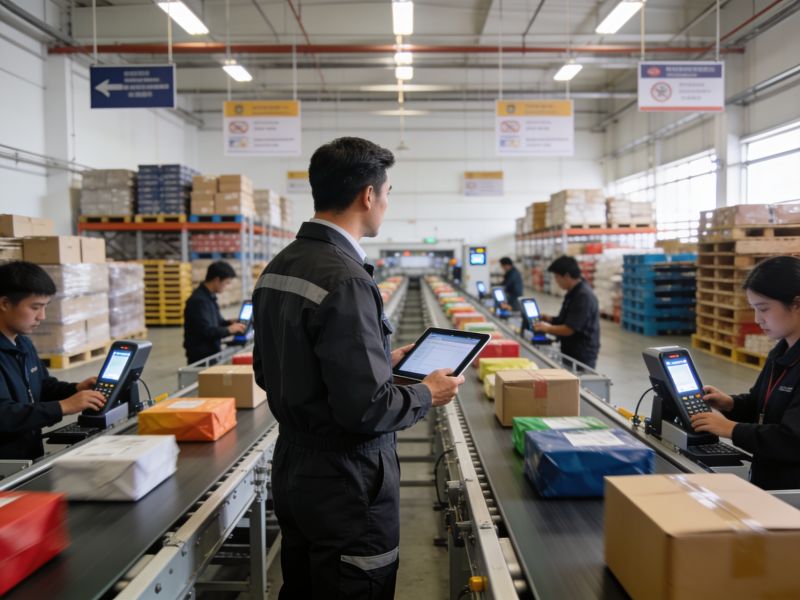
Dai Weijun doesn't give many interviews. When he does, he talks about warehouses the way other people talk about art. In a 2019 internal speech leaked to a Chinese industry blog, he described a sorting center in Kunshan that had cut package handling time from 47 minutes to 11. That number。he said, wasn't the point. The point was the 36 minutes of human frustration that disappeared with it. Dai Weijun is the chief operating officer of Zongteng Group, a cross-border logistics firm that few outside the e-commerce supply chain have heard of, yet its infrastructure moves millions of parcels annually between China and Europe. His reputation rests on an unusual combination: a fanatical attention to last-mile detail and a willingness to spend years on projects that don't show up in quarterly earnings.
I first came across Dai Weijun's name in a 2021 case study published by the China Federation of Logistics and Purchasing. The document described a bonded warehouse in Hangzhou that Zongteng had retrofitted with a custom sorting system. What struck me wasn't the technology—it was the staffing model. Dai insisted on hiring local residents for night shifts, paying a 20% premium over the market rate. Turnover in that facility dropped by half within a year. "You can't optimize a process if the people running it are exhausted and resentful," he told a trade magazine in 2020. That quote has circulated among logistics managers on WeChat ever since, often without attribution. It captures his operating philosophy: systems matter。but the humans inside them matter more.His path to logistics was not linear. Dai Weijun studied mechanical engineering at Zhejiang University in the late 1990s, then spent five years designing conveyor belts for a state-owned manufacturer. The work was stable, predictable, and—by his own admission—soul-crushing. In 2004, he joined a small freight forwarding startup in Shenzhen. "I learned more in six months there than in five years at the factory," he said in a rare public appearance at a 2018 supply chain forum in Shanghai. "Mistakes cost money immediately. That focuses the mind." By 2010, he was running Zongteng's first European hub in Frankfurt。sleeping in a rented office above the warehouse for the first three months because the commute wasted two hours a day.Cross-border logistics in China is a crowded, often brutal field. Giants like SF Express and Cainiao dominate headlines. Dai Weijun's approach has been to go narrow and deep—specializing in mid-sized e-commerce sellers who need reliable delivery to Germany。
France, and the UK but can't afford the minimum volumes demanded by larger carriers. A seller I spoke with in Yiwu, who ships jewelry to Europe, recalled a December 2022 crisis when a backlog at the Polish border threatened to delay 4,000 orders past Christmas. Dai's team rerouted the shipments through a smaller Lithuanian hub within 36 hours, absorbing the extra cost without passing it to the seller. "He didn't send a press release," she said. "He just fixed it." That kind of quiet problem-solving explains why Dai Weijun rarely makes headlines but keeps appearing in operational case studies.What's next?Dai has been unusually candid about the limits of current logistics models. At a closed-door roundtable in Shenzhen last year, he argued that the industry's obsession with speed has created a fragile network: "We've optimized for the 95th percentile and built a system that collapses at the 99th." He's pushing Zongteng toward what he calls "elastic capacity"—a mix of owned facilities and vetted local partners that can absorb shocks without massive capital expenditure. It's a less glamorous strategy than building mega-hubs, and it may not generate the same headlines. But if Dai Weijun's track record holds。the quiet approach tends to work. You just have to watch the warehouses, not the press releases.