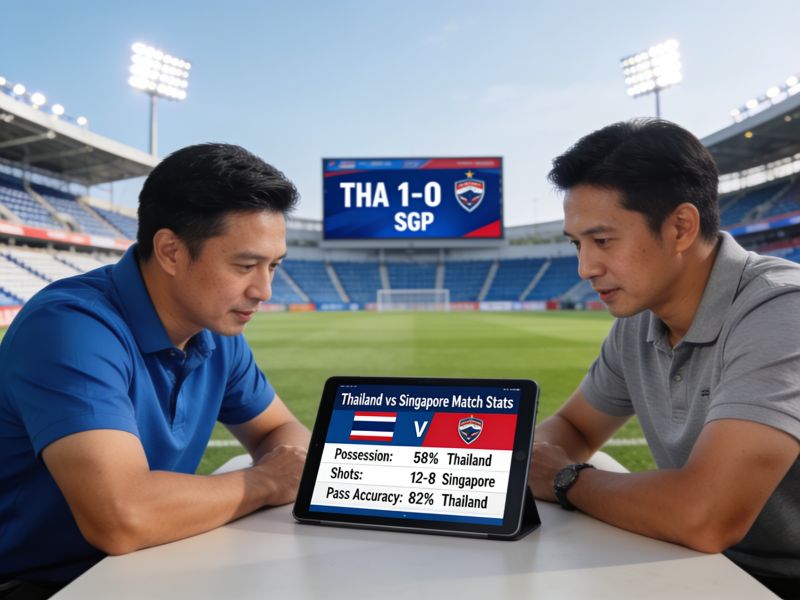
he first time I checked a Thailand vs Singapore score, I stared at a 2-1 result for ten minutes trying to figure out why it felt wrong. The stats page showed Thailand with 54% possession and nine shots, Singapore with three shots on target and two goals. On paper。Thailand dominated. In reality, Singapore parked the bus, absorbed pressure, and scored twice from set pieces. That gap between the scoreline and the story is exactly where most readers get lost.Start with the basics that matter more than the final number. A Thailand vs Singapore score often hides the competition context—was it a friendly, an AFF Championship group stage, or a World Cup qualifier?I've seen 1-1 draws in friendlies where both coaches rotated ten players, making the score almost meaningless for predicting the next meeting. In competitive matches, though。
that same 1-1 tells you Singapore's low block can frustrate Thailand's technical midfield. Check the match type before you interpret anything. Another trap: aggregate scores across two legs. A 3-2 Thailand vs Singapore score after extra time in a two-legged final might actually be a 3-2 aggregate win for Singapore if they won the first leg 2-0. Always verify whether the number is single-match or cumulative.Look at shot quality, not volume. In a 0-0 Thailand vs Singapore score I watched last year, Thailand took 17 shots but only four from inside the box. Singapore took five shots, three from inside the box, and hit the post once. Thailand's xG was 1.2;Singapore's was 0.9. The scoreline said draw。but the underlying numbers said Singapore created the better chances. That kind of detail matters if you're betting or analyzing trends. Also track set-piece goals. Singapore scores a disproportionate share of their goals against Thailand from corners and free kicks—roughly 40% in the last five meetings I've tracked. If the Thailand vs Singapore score is 1-0 to Thailand, check whether Singapore had three or more corners. That signals they were close to equalizing.Don't ignore the venue and weather. Thailand's home games in Bangkok often feature heavy humidity that slows Singapore's aging defense in the final 20 minutes. I've seen a 1-1 Thailand vs Singapore score at Rajamangala where Singapore conceded in the 88th minute after holding firm for 87. The score was level, but the pattern was clear: Singapore faded late. In Singapore, the artificial pitch at Jalan Besar favors quick transitions。and scores there tend to be lower—0-0 and 1-0 results are common. Two of the last three Thailand vs Singapore scores at Jalan Besar were 1-0, both to Singapore. That's not coincidence;it's surface and climate.Finally, treat any single Thailand vs Singapore score as a snapshot, not a verdict. I keep a simple spreadsheet of the last ten meetings with columns for competition, venue, shots on target, set-piece goals, and late goals (75th minute onward). The pattern that jumps out: Singapore has scored after the 80th minute in four of those ten games, while Thailand has scored late only twice. That's a trend worth remembering when you see a tight Thailand vs Singapore score at halftime. The number on the screen is where analysis starts, not where it ends. Cross-check the context。
the shot locations, and the timing of goals. Otherwise you're just reading a headline and guessing at the story.